
NEEDLE FELTING FAQS

What is 3D Needle Felting?
3D needle felting is a craft technique that transforms loose wool fibers into three-dimensional sculptures or objects by repeatedly stabbing them with specialized barbed needles. This method allows artists to create intricate, lifelike shapes such as animals, figures, or decorative items by manipulating wool density, texture, and form through strategic needling. Unlike flat felting, 3D needle felting focuses on building depth and dimension, enabling the creation of standalone, sculptural pieces.

The Historical Evolution of Needle Felting Techniques
Origins in Industrial Textile Manufacturing
The foundations of needle felting trace back to the 19th century, when textile industries developed mechanical needle-punching to produce non-woven fabrics. Barbed needles were used to compact loose wool into dense, cohesive sheets without the need for water or weaving. This industrial process laid the groundwork for artistic adaptations, though it wasn’t until much later that these techniques were repurposed for sculptural purposes.
Transition to an Artistic Medium
The leap from industry to art occurred in 1981, when American fiber artists David and Eleanor Stanwood began experimenting with industrial felting needles in their studio. Their work revealed that controlled, hand-guided needling could shape wool into detailed forms beyond flat textiles. This innovation coincided with the rise of the DIY craft movement, sparking widespread interest. In the early 1990s, Japanese artist Ayala Talpai advanced the craft further by authoring instructional books, establishing a methodological framework that remains influential today.
Advances in Tools and Materials
The 21st century brought significant enhancements to needle felting:
- Specialized Needles: Manufacturers introduced needles with varied barb designs (e.g., star-shaped, twisted, or crown-tipped), offering artists precise control over fiber penetration and alignment.
- Armature Systems: The integration of aluminum or brass wire frames provided structural support for dynamic poses, such as articulated limbs in animal sculptures.
- Fiber Blends: Suppliers began offering curated wool mixes, combining coarse Romney wool for structural strength with fine Merino for detailed finishing, optimizing both durability and aesthetics.
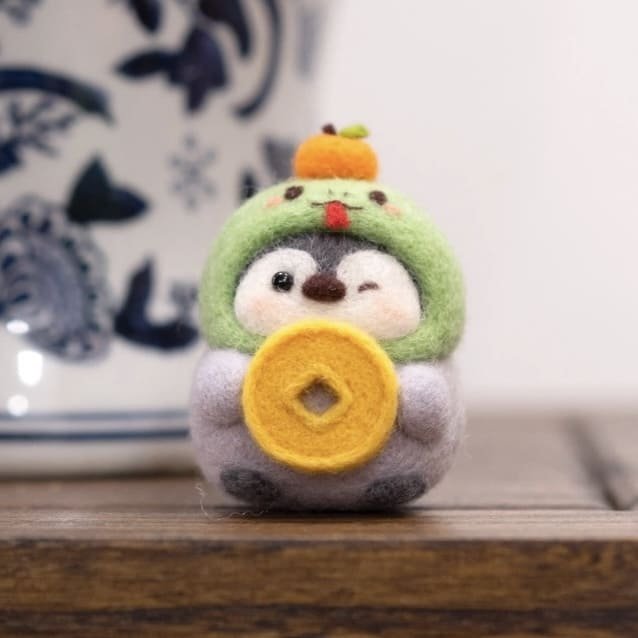
Essential Materials: Tools and Fibers in 3D Needle Felting
How Felting Needles Work
Modern felting needles feature triangular or star-shaped cross-sections with angled barbs along the shaft. When plunged into wool, these barbs:
- Catch Fibers: During the downward stroke (0.5–1.5 cm depth).
- Pull Fibers: On the upward withdrawal, drawing them inward.
- Entangle Scales: Through repeated punctures, locking the wool into place.
Needles are categorized by gauge in a reverse numbering system:
- Coarse (32–36 gauge): Thick shafts (0.6–0.8 mm) with 6–8 barbs/cm for rapid compaction.
- Medium (38–40 gauge): Versatile for general shaping (0.4–0.6 mm).
- Fine (42–43 gauge): Ultra-thin (0.3–0.35 mm) with 12–15 barbs/cm for surface detailing.
Choosing the Right Fibers
Wool Varieties
- Core Fibers:
- Corriedale: Medium-coarse (35–40 microns) for structural density.
- Bluefaced Leicester: Long staple (15–20 cm) resists breaking under heavy needling.
- Surface Fibers:
- Merino: Fine (18–22 microns) for smooth finishes, though it requires more needling.
- Angora: Adds a soft halo effect for feathers or fur.
Synthetic Additions
- Nylon (15–20% blend): Boosts tensile strength for fine protrusions like whiskers.
- Luster Fibers: Metallic polyester adds reflective highlights without compromising feltability.
Setting Up Your Workspace
A professional setup typically includes:
- Foam Pad: Adjustable density (30–90 kg/m³) to support the work.
- Rotating Platform: Enhances ergonomic access.
- Magnification: 3–5x lenses for intricate details.
- Humidity Control: 40–50% relative humidity to reduce static.

The Process: Turning Fibers into 3D Forms
Building an Armature
Wire frames provide anatomical scaffolding:
- Mammal Proportions: Head (1/5 height), torso (3/5), limbs (1/5).
- Bird Proportions: Wingspan (2.2x body length), tail (1.3x torso).
Artists wrap the frame with coarse wool or roving to create a grippy base for subsequent layers.
Layering Techniques
- Core Bulking: Romney wool is wrapped around the armature and compacted with a 38-gauge needle in a spiral pattern (45° angle), targeting a density of 0.25 g/cm³.
- Muscle Shaping: Corriedale wool defines contours with alternating vertical and horizontal needling, reaching 0.35 g/cm³.
- Surface Finishing: Merino strips (0.5 mm thick) are applied in 2–3 mm tufts using a 42-gauge needle at an 85° angle, achieving a final density of 0.45 g/cm³.
Advanced Sculpting Methods
- Subtractive Carving: Reverse-barbed needles remove fibers to form recesses.
- Inlaying: Pre-felted shapes are embedded into the main form.
- Hybrid Techniques: Combine wet-felted elements with needle-felted details.
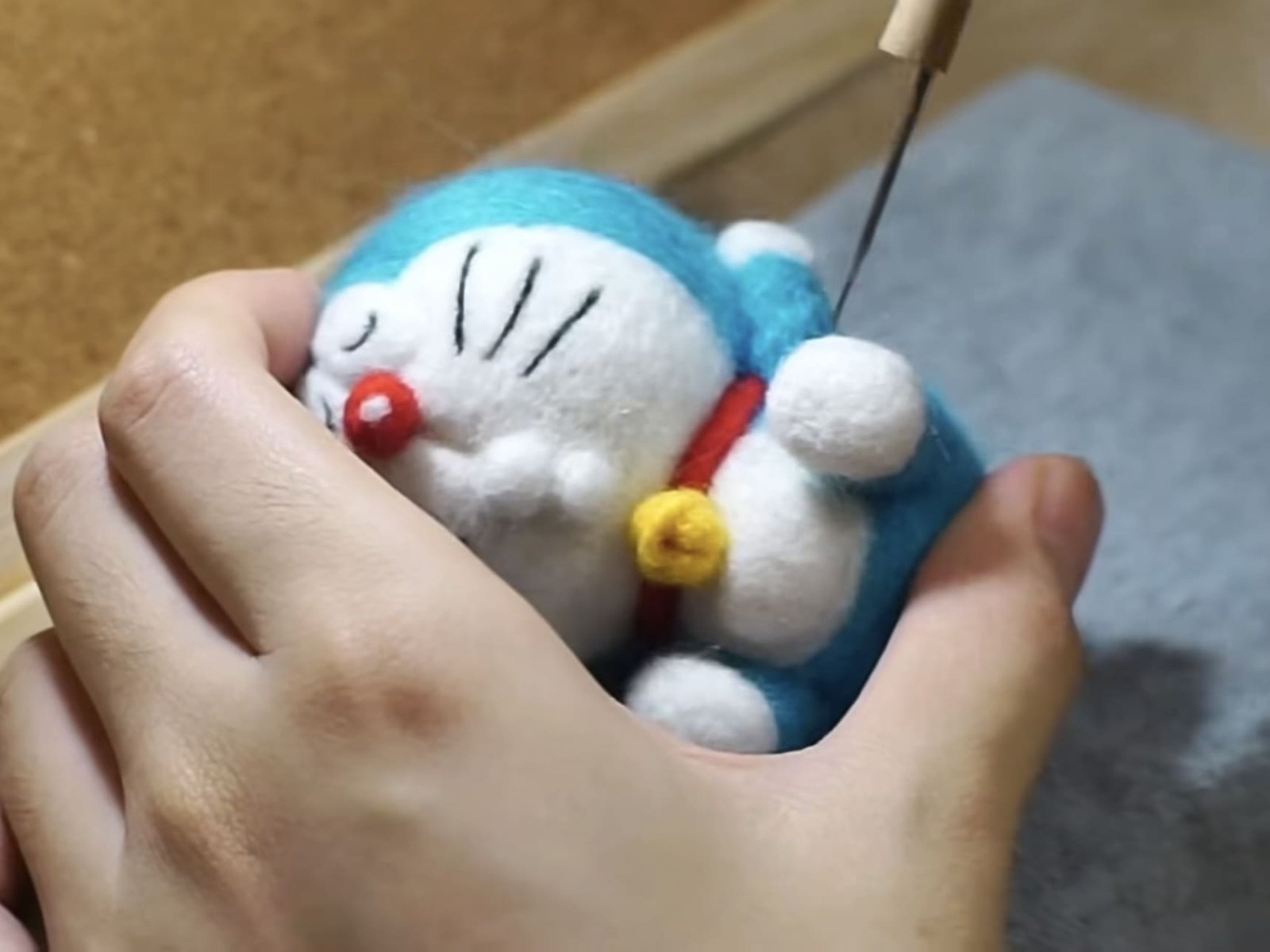
Artistic Considerations in 3D Needle Felting
Anatomical Precision
For bird sculptures:
- Feather Mapping: Flight feathers use layered strips with notched shafts; coverts are cross-needled for overlap.
- Eye Placement: Predators (30° side angle), prey (180° frontal).
Color Dynamics
- Undercoating: Dark core wool deepens surface tones.
- Optical Blending: Alternating red/blue fibers yield vibrant purples.
- Weathering: Gray roots with brown tips mimic aged fur.
Adding Movement
- Articulated Joints: Stainless steel rivets enable limb motion.
- Magnetic Features: Neodymium magnets attach detachable parts.

Overcoming Challenges in Needle Felting
Structural Issues
- Sagging: Caused by low core density (<0.2 g/cm³). Fix with 36-gauge star needles at 2 mm depth.
- Shedding: Due to insufficient surface needling (<500 punctures/cm²). Stabilize with a 10% gelatin solution.
Detail Limitations
- Blurriness: From needle deflection. Use tungsten carbide needles (0.2 mm tip).
- Scale Mismatch: Oversized fibers obscure details. Comb wool through 120-micron cloth first.
Modern Applications and Innovations
Educational Models
- Medical Training: Felted organs with nylon-reinforced tumors or silk-wrapped vessels.
- Sustainable Art: Biodegradable sculptures preserved with linseed oil or upcycled textile armatures.
Tech Integration
- 3D Scanning: Digitizes reference models for armature templates.
- Laser Guidance: Projects needling patterns for complex designs.
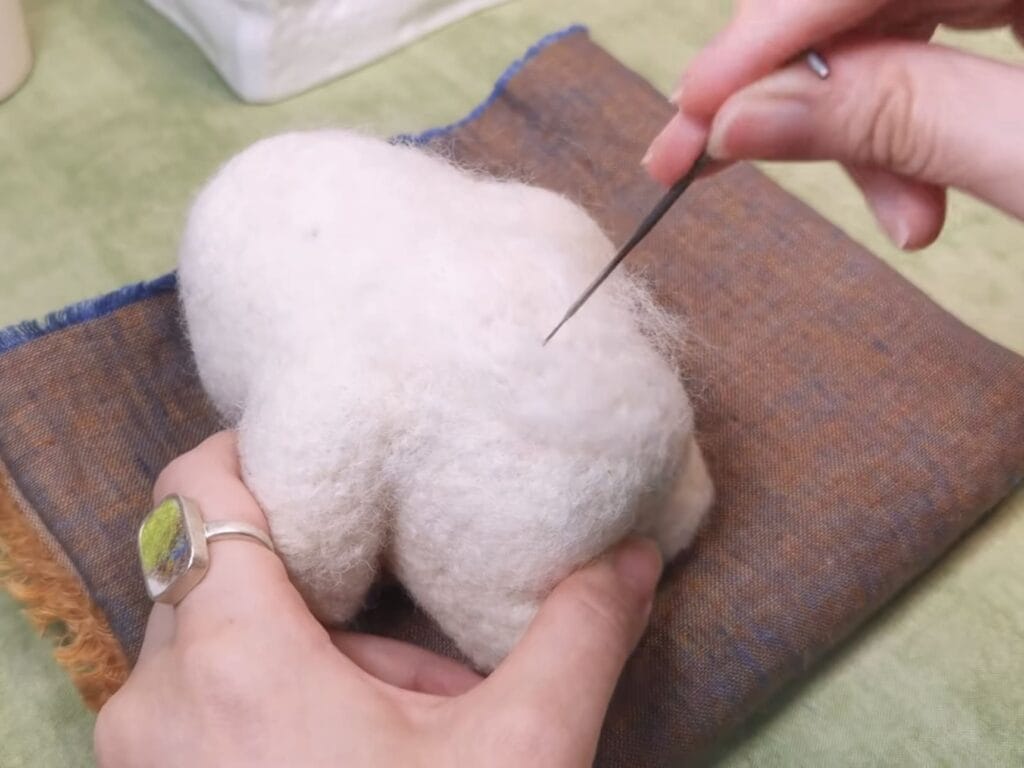
Conclusion: The Ever-Evolving World of 3D Needle Felting
What is 3D needle felting? It’s an art form that has grown from a niche craft into a sophisticated discipline, blending material science with sculptural mastery. As artists explore innovations like nano-coated needles or bio-responsive fibers, the medium retains its tactile, organic essence. For aspiring creators, mastering 3D needle felting demands dexterity, an understanding of fiber behavior, and a passion for blending art with science—a rewarding journey at the intersection of creativity and craft.
HailMaryPDFwaina
In the process of creation, the plasticity of wool is also very strong, and it can be easily poked into various shapes, and the formed work is stable and beautiful.
LasMujeresPDFwaina
Needle feelinging is a very healing manual activity, and every creation can make me feel relaxed and happy.
MetabolicFreedomwaina
Reset your metabolism without extreme fasting, endless cardio, or confusing meal plans – just clarity. https://metabolicfreedom.top/ metabolic freedom book pdf download
PerplexityKupitwaina
perplexity аккаунт https://uniqueartworks.ru/perplexity-kupit.html
Australian
I look forward to continuing to explore more possibilities of needle felting and creating more unique works.
호빠
I got this site from my buddy who informed me about this web page and now this time I
am browsing this website and reading very informative articles at this time.
Http://boyarka-Inform.com/
The wool is mixed with a little glitter, and the unicorn mane created by needle felting has a built-in galaxy effect.
https://www.harvard.edu/
I made a cat collar bell using needle felting. It’s so light that my cat doesn’t even notice it, but it’s gotten a bunch of compliments from my neighbors.
http://boyarka-inform.com/
The shop even provided biodegradable storage bags, so the leftover scraps from needle felting could also be stored in an environmentally friendly way.
Ava Celeste Donovan
Please me, is this 3D needle felting easy to do?